Abstract
Access to clean and efficient household energy remains a major challenge in developing countries, where more than 4 billion people still rely on traditional biomass for cooking. In Ethiopia, injera baking is the most energy-intensive household activity, consuming about 50% of total household biomass energy use annually. Traditional three-stone stoves used for injera baking are associated with low thermal efficiencies (5–10%), high fuel consumption, indoor air pollution, and health risks. This study aimed to evaluate the thermal performance of a Top-Lit Updraft (TLUD) injera baking stove under real household conditions in Digga and Caliya districts of Western Ethiopia. The stove was constructed using a 60 cm clay pan, mild steel sheet, fiberglass insulation, aluminum sheet, and square pipe framing. Three households were selected for experimental evaluation using 3 kg of eucalyptus wood per test. Temperature profiles, fuel consumption, biochar production, and baking performance were measured using digital instruments. Results showed that the TLUD stove achieved an average thermal efficiency of 25.2%, significantly higher than the 5–10% efficiency typical of traditional stoves. Pan temperatures remained within the optimal injera baking range of 180–209°C, while baking time averaged 2.14 minutes per injera. Fuel consumption was reduced by 50–60%, and each test produced 326–426 g of biochar. Compared to traditional three-stone stoves, the TLUD stove demonstrated substantial improvements in efficiency, energy savings, safety, and environmental performance. The study concludes that TLUD stoves present a viable, clean, and efficient alternative for injera baking at household level. Further work is recommended on emission testing and user perception studies.
Keywords
Biochar, Biomass Fuel, Household Energy, Improved Cook Stove, Injera Baking, Thermal Efficiency, TLUD Stove
1. Background and Justification
Globally, there are approximately 1.2 billion people without access to electricity, and 4 billion people who rely on biomass for cooking
| [12] | World Health Organization. (2018). Household air pollution and health. WHO Press. |
[12]
. The traditional and inefficient use of biomass creates a number of problems which include an estimated 4 million of annual deaths with indoor air pollution
| [12] | World Health Organization. (2018). Household air pollution and health. WHO Press. |
[12]
. More than 50% of the premature deaths of children below 5 years are caused by the presence of particulate matter because of the use of biomass
| [13] | World Health Organization. (2021). Household fuel combustion and indoor air quality guidelines. WHO Press. |
[13]
. In Ethiopia, the national electrification rate is around 25%, being 85% in the urban areas and 10% in the rural areas
| [8] | International Energy Agency. (2017). Energy access outlook: World energy outlook special report. IEA. |
[8]
. In developing countries, most people use three-stone fires for cooking or baking applications.
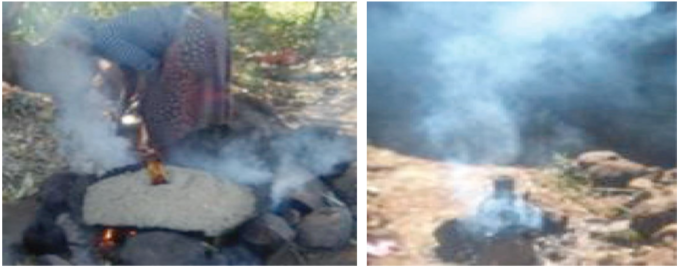
The majority of households complete their injera baking system by using an open fireplace, three stones, which is a wasteful and ineffective baking technique. The most in-depth household interest is the injera baking method, which accounts for about 50% of the biomass power consumption per family over a 12 month period
| [6] | Guta, D. D., Beyene, A. D., & Koch, S. F. (2021). Household biomass energy use for injera baking in Ethiopia. Renewable and Sustainable Energy Reviews, 135, 110–115.
https://doi.org/10.1016/j.rser.2020.110115 |
[6]
. Furthermore, open fire pits expose people to air pollution (nitrous oxides, carbon monoxide, particulate matter, carcinogens, and others) both acutely and continuously
| [3] | Bruce, N., & Gordon, S. B. (2008). Indoor air pollution in developing countries: A major environmental and public health challenge. Bulletin of the World Health Organization, 86(5), 395–396. https://doi.org/10.2471/blt.08.052605 |
[3]
. Consequently, family air pollution exposure has been connected to a number of detrimental health outcomes in both children and adults, including low birth weight, premature death, lung cancer, TB, pneumonia, and chronic obstructive pulmonary disease
.
The main victims are usually women and young children, who are often carried on the mother's back while cooking. These traditional wood fires also imply a high risk of burns and scalds especially on children.
Figure 1. Three stone traditional wood fire.
Additionally, the unsustainable use of fuel wood damages nearby forests, contributing to the nation’s high deforestation rate. With an efficiency of only 5–10%, this traditional three stone baking stove appears to operate at a relatively low level, leading to wooden consumption and thermal energy loss throughout the injera baking process
. A number of efforts are underway to improve the performance of traditional biomass cooking stoves. In early stages of development, the focus was on improving specific parts of the stove such as the grate, skirt and insulation. However, nowadays, researches focus on reducing the emissions and increase the energy efficiency. Currently, the GIZ and international companies such as lakech, gonze, mirt, and rocket (tikikil) stoves are promoting and distributing cooking range innovations.
However, because of incomplete combustion (direct combustion) of the biomass, these stoves are no longer just less environmentally friendly but also produce excessive amounts of indoor air pollutants. Therefore, in rural areas, affordable, practical, and clean cooking and baking technologies are needed to reduce indoor air pollution and associated fuel consumption costs. Among the different types of improved cook stoves, advanced biomass gasifier stoves are the subject of current research interest since they are more efficient, have lower emissions, are safer, and have high durability. However, these highly efficient cook stoves have not been designed or tested in such a way that whether they are suitable to cook stoves for baking injera is unknown in Ethiopia since injera baking is a highly energy intensive process and requires special design techniques.
In order to solve the problem the Top-Lit UpDraft (TLUD) stove represents an efficient alternative by promoting clean combustion through staged air supply and gasification. This study aimed to evaluate the thermal performance of TLUD injera baking stoves powered by biomass fuel under real-world conditions.
2. Materials and Methods
2.1. Materials
The TLUD injera baking stove was constructed using the following materials are: 60cm diameter and 2cm thickness clay pan, Mild steel (1.5mm thickness), Fiberglass insulation (40mm thickness), Aluminum sheet (1mm thickness) and Square pipe (20×20×2mm).
2.2. Instruments
1) Digital balance,
2) infrared thermometer,
3) hygrometer, Multimeter integrated with thermocouple, measure cylinder, sieve, digital moisture meter and measuring tape.
2.3. Experimental Set up
1) Three voluntary farmers house from Digga and Caliyya were selected.
2) The stove was placed on a stable, heat-resistant surface at each site.
3) 3 kg of Eucalyptus fuel wood was weighed and loaded continually into the TLUD combustion chamber.
4) Batter was prepared by mixing ratio of 30% flour to 70% water and starter culture.
5) Thermometers were positioned to record stove surface and pan temperatures during operation.
6) Biochar collection trays were positioned to capture residues.
2.4. Experimental Procedure
1) Fuel loading: 3 kg of Eucalyptus wood was loaded into the stove; moisture content was measured and recorded (6.5–18%)
2) Ignition: Fuel was lit from the bottom using kindling; the flame was allowed to stabilize
3) Batter praparation: 3 kg teff flour was mixed with 5 L water and starter culture (ersho)
4) The batter were weighted before starting the test and then poured onto the preheated clay pan
5) Cooking time and pan temperature, fuel consumption, char production, pan, body, injera, chimney, and the ambeint temperature were measured
6) The data was taken continuously upto the required quantity of injeras finally, the remaining unburned biomass, and weighed to obtain the injeras produced
2.5. Fuel Characterization
The feedstock used for the experiment was eucalyptus tree wood cut into small pieces and sun-dried for at least three to four weeks to reduce the moisture content. This type of wood has commonly used for injera baking in rural areas of Ethiopia.
Table 1.
The characterization of Eucalyptus wood according to | [2] | ASTM International. (2011). Standard test methods for proximate analysis of solid biomass fuels (ASTM E870-82). ASTM International. |
Characteristics | Eucalyptus wood |
Bulk density (kg/m3) | 480 |
Calorific value (MJ/kg) | 18.64 |
HVfuel (KJ/kg) | 18640 |
HVchar (KJ/kg) | 27973 |
Hfg (KJ/kg) | 2260 |
2.6. Parameters Calculated for Stove Performance Evaluation
The amount of energy used to bake injera is a combination of sensible and latent heat used to evaporate the water and bake the injera to the required quality. The mass of evaporated water can be obtained from the difference between the initial weight of the batter and the final baked injera
.
The energy utilized to bake injera (Qinjera) was computed by using Eqn.
Qinjera = mbatter× Cp batter (Tboil-Tbatter) + (mevap) hfg
Where, Mevap is mass of water evaporated during injera baking (kg), hfg is latent heat vaporization of water (KJ/ kg. k).
Specific fuel consumption
The specific fuel consumption (SFC) is the amount of fuel consumed per unit of food cooked, in g/kg of
injera, calculated according to the controlled cooking stove testing protocol
| [3] | Bruce, N., & Gordon, S. B. (2008). Indoor air pollution in developing countries: A major environmental and public health challenge. Bulletin of the World Health Organization, 86(5), 395–396. https://doi.org/10.2471/blt.08.052605 |
[3]
.
SFC=fd/wf*100%
𝑓d = (Fi-Ff) × [1-(1.12×m)]-1.5×mchar
Where: 𝑓d is equivalent fuel wood, Fi is the initial weight of fuel (g), Ff is the final weight of fuel (g), m is moisture content (%), m char is mass of char (g).
Where: Wf is the weight of food, pf is the weight of injera with the plate, P is the weight of the plate.
Thermal efficiency
The thermal efficiencies of both three-stone fire and injera baking biomass stoves were calculated as the ratio of useful energy to the net energy input.
The thermal efficiency was calculated using Eqn.
µ=
The specific heat capacity of injera was obtained from Eq below considering 70 percent water and 30 percent
teff flour in the injera
.
Cp, injera = 1.337+6.998xm-5.336 -0.05185lnT1
2.7. Data Analysis Methods
The injera baking biomass stove efficiency was evaluated by comparing it with the three-stone open fire using Eucalyptus wood. The collected data were analyzed by using excel software and Simple descriptive statistics.
3. Result and Discussion
3.1. Temperature Profiles
Test 1
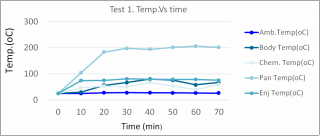
Figure 1 shows the temperature profiles for Digga. Ambient temperature ranged from 25.1°C to 28°C, with an average of 26.9°C, Pan temperature increased rapidly from 104°C to a peak of 206°C, with an average of 201.4°C, Injera temperature ranged from 74°C to 80.7°C, with an average of 77.4°C, Stove body temperature ranged from 30°C to 80°C, while chimney temperature ranged from 40°C to 67°C.
Figure 2. Temperatures vs time test 1.
Test 2
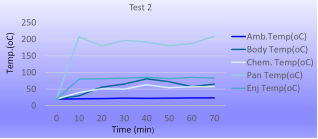
Figure 2 shows the temperature profiles for Digga. Ambient temperature ranged from 20°C to 23.6°C, with an average of 21.9°C., Pan Temperature ranged from 180°C to 209°C, with an average of 193.3°C, Injera temperature ranged from 80.2°C to 85.4°C, with an average of 82.7°C and Stove body temperature ranged from 30°C to 81°C, while chimney temperature ranged from 40°C to 63°C.
Figure 3. Temperatures vs time test 2.
Test 3
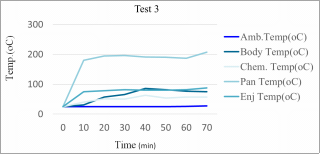
Figure shows the temperature profiles for Caliya woreda. Ambient temperature ranged from 19°C to 22.3°C, with an average of 21.1°C, Pan Temperature ranged from 180.4°C to 207.7°C, with an average of 192.6°C, Injera temperature ranged from 75.2°C to 88.1°C, with an average of 80.8°C, Stove body temperature ranged from 31°C to 86°C, while chimney temperature ranged from 40°C to 63°C.
Figure 4. Temperatures vs time test 3.
The temperature profiles across all three tests showed consistent pan temperatures in the range of 180-209°C, which is related with the result reported 170-220°C for injera baking
| [4] | Gebreegziabher, Z., Mekonnen, A., Kassie, M., & Köhlin, G. (2018). Household fuel consumption and energy efficiency of injera baking stoves in Ethiopia. Energy for Sustainable Development, 44, 72–80. https://doi.org/10.1016/j.esd.2018.03.002 |
[4]
. The pan temperature was maintained within this range throughout the baking process, indicating good thermal stability of the TLUD stove design, Injera temperatures ranged from 74°C to 88.1°C, with average values between 77.4°C and 82.7°C across the three tests. These temperatures are suitable for proper cooking of injera, which typically requires temperatures between 70°C and 90°C
| [1] | Adhikari, R., Shrestha, S., & Kafle, G. K. (2018). Thermal requirements and performance characteristics of injera baking systems. Energy for Sustainable Development, 45, 1–9.
https://doi.org/10.1016/j.esd.2018.05.003 |
[1]
.
The stove body temperature ranged from 30°C to 86°C, while chimney temperatures ranged from 40°C to 67°C. These relatively low temperatures indicate good insulation of the stove body, which contributes to higher thermal efficiency by reducing heat loss to the surroundings.
Test 1, conducted in the afternoon, showed slightly higher ambient temperatures (average 26.9°C) compared to Test 2 (average 21.9°C) and Test 3 (average 21.1°C). However, this did not significantly affect the stove's performance, as pan and injera temperatures remained within the optimal range across all tests.
3.2. Measured Data Results
Table 2. Summarizes the measured data for the three tests.
Parameter | Test 1 | Test 2 | Test 3 | Average |
Number of injeras baked | 15 | 15 | 15 | 15 |
Av. mass of batter per injera (g) | 767 | 658 | 672 | 699 |
Av. mass of baked injera (g) | 423 | 323 | 363 | 370 |
Av. Biochar produced (g) | 349 | 326 | 426 | 367 |
Av. baking time (min) | 2.05 | 2.17 | 2.22 | 2.14 |
Av. relative humadity (%) | 34.5 | 46 | 53.1 | 46 |
Time interval between baking (min) | 2 | 2 | 2 | 2 |
3.3. Thermal Efficiency
Table 3. Summary of the thermal efficiency calculations for the three tests.
Parameter | Test 1 | Test 2 | Test 3 | Average |
Biomass used (kg) | 2.43 | 2.8 | 3 | 2.74 |
Av. Moisture content (%) | 6.5 | 6 | 18 | 16.5 |
Energy input (MJ) | 47.52 | 47.52 | 47.52 | 47.52 |
Energy to evaporate water (MJ) | 11.66 | 11.36 | 10.48 | 11.17 |
Energy to cook injera (MJ) | 0.86 | 0.75 | 0.76 | 0.79 |
Total useful energy (MJ) | 12.52 | 12.11 | 11.24 | 11.96 |
Thermal efficiency (%) | 26.3 | 25.5 | 23.7 | 25.2 |
The average thermal efficiency of the TLUD injera baking stove was 25.2%, with individual test efficiencies ranging from 23.7% to 26.3%. This is significantly higher than traditional clay mitads, which typically have thermal efficiencies of 5-10%
| [4] | Gebreegziabher, Z., Mekonnen, A., Kassie, M., & Köhlin, G. (2018). Household fuel consumption and energy efficiency of injera baking stoves in Ethiopia. Energy for Sustainable Development, 44, 72–80. https://doi.org/10.1016/j.esd.2018.03.002 |
[4]
. The highest efficiency was observed in Test 1 (26.3%), which had the highest water evaporation rate compared to the other tests. This suggests that the stove performs better when more water needs to be evaporated from the batter, as the energy transfer to the pan is more efficient. The thermal efficiency of the TLUD stove is comparable to other improved biomass stoves reported in the literature, which typically range from 20 to 40%
| [10] | MacCarty, N., Still, D., & Ogle, D. (2010). Fuel use and emissions performance of fifty cooking stoves in the laboratory and related benchmarks of performance. Energy for Sustainable Development, 14(3), 161–171.
https://doi.org/10.1016/j.esd.2010.06.002 |
[10]
.
Table 4. Comparison with Traditional Injera Baking Stoves.
Parameter | TLUD Stove | Traditional Stove | Advantage |
Thermal efficiency (%) | 23.7-26.3 | 5-10 | 26-68% improvement |
Fuel consumption (kg for 15 injeras) | 2.43-3 | 5-7 | 50-60% reduction |
Baking time (min per injera) | 2.05-22 | 3-5 | 30-50% reduction |
Biochar production | Yes (367g average) | No | Additional valuable product |
Traditional mitads typically have thermal efficiencies of 5-10%, compared to 25.2% for the TLUD stove
| [4] | Gebreegziabher, Z., Mekonnen, A., Kassie, M., & Köhlin, G. (2018). Household fuel consumption and energy efficiency of injera baking stoves in Ethiopia. Energy for Sustainable Development, 44, 72–80. https://doi.org/10.1016/j.esd.2018.03.002 |
[4]
. This means the TLUD stove uses less fuel to bake the same number of injeras.
Traditional stoves typically require 5-7 kg of wood to bake 15 injeras
| [1] | Adhikari, R., Shrestha, S., & Kafle, G. K. (2018). Thermal requirements and performance characteristics of injera baking systems. Energy for Sustainable Development, 45, 1–9.
https://doi.org/10.1016/j.esd.2018.05.003 |
[1]
, while the TLUD stove used only up to 3 kg of eucalyptus biomass. This represents a fuel savings of 50-60%.
Traditional stoves typically require 3-5 minutes per injera
, while the TLUD stove achieved baking times of 2.05-2.23 minutes per injera. This represents a time savings of 30-50%.
The TLUD stove produced biochar as a byproduct (326-426g per test), which can be used as a soil amendment or fuel. Traditional stoves do not produce biochar, as they rely on complete combustion of the biomass
| [9] | Lehmann, J., & Joseph, S. (2015). Biochar for environmental management: Science, technology and implementation (2nd ed.). Routledge. |
[9]
. While not directly measured in this study, TLUD stoves are known to produce lower emissions compared to traditional stoves due to more complete combustion
| [10] | MacCarty, N., Still, D., & Ogle, D. (2010). Fuel use and emissions performance of fifty cooking stoves in the laboratory and related benchmarks of performance. Energy for Sustainable Development, 14(3), 161–171.
https://doi.org/10.1016/j.esd.2010.06.002 |
[10]
. This has significant health benefits, particularly for women and children who are often exposed to indoor air pollution from traditional cooking stoves.
The average mass of batter per injera varied between tests (658-767g), which affected the water evaporation rate and consequently the thermal efficiency. Test 1, which had the highest batter mass (767g), showed the highest thermal efficiency (26.3%).
4. Conclusions and Recommendations
4.1. Conclusions
This study evaluated the thermal performance of a TLUD injera baking stove at a small farmer's house level. The results demonstrated that the TLUD stove achieved an average thermal efficiency of 25.2%, which is significantly higher than traditional clay mitads (5-10%). The stove was able to bake 15 injeras using only 3 kg of eucalyptus biomass, with an average baking time of 2.14 minutes per injera. Temperature profiles showed consistent pan temperatures in the optimal range of 180-209°C for injera baking, with good thermal stability throughout the baking process. The stove also produced biochar as a valuable byproduct, ranging from 326g to 426g per test.
Compared to traditional baking stoves, the TLUD stove offers several advantages, including higher thermal efficiency, lower fuel consumption, faster baking times, and biochar production. These benefits make TLUD technology a promising alternative to traditional injera baking methods, particularly for small-scale farmers who could benefit from both fuel savings and the agricultural benefits of biochar.
4.2. Recommendations
Based on the findings of this study, the following recommendations are made.
1) The TLUD injera baking should be recommended for rural and pre urban household families and also for urban where biomass is available.
2) Therefore, it is better to use and popularize it for household baking purposes.
3) Since the technology was performed better than traditional baking methods by most of thermal indicators, it was recommended to be demonstrate and collect end users comment for further dissemination.
4) Emission Testing: Future studies should include emission testing to quantify the health and environmental benefits of TLUD stoves.
Abbreviations
𝑓d | Equivalent Fuel Wood |
HVf | Heating Value of Fuel |
HVc | Heating Value of Char |
Pf | Weight of Injera with the Plate |
P | Weight of the Plate |
TLUD | Top-Lit Updraft |
SFC | Specific Fuel Consumption |
Wf | Weight of Food |
Acknowledgments
The author extends sincere gratitude to the Department of sustainable energy engineering at Bako agricultural engineering research center and work shorpworkers, the residents of East Wollega and West Showa for their cooperation, and all individuals who contributed to the fabrication, and testing of the TLUD injera stove. Their support was invaluable in completing this study.
Conflicts of Interest
The authors declare no conflicts of interest.
References
| [1] |
Adhikari, R., Shrestha, S., & Kafle, G. K. (2018). Thermal requirements and performance characteristics of injera baking systems. Energy for Sustainable Development, 45, 1–9.
https://doi.org/10.1016/j.esd.2018.05.003
|
| [2] |
ASTM International. (2011). Standard test methods for proximate analysis of solid biomass fuels (ASTM E870-82). ASTM International.
|
| [3] |
Bruce, N., & Gordon, S. B. (2008). Indoor air pollution in developing countries: A major environmental and public health challenge. Bulletin of the World Health Organization, 86(5), 395–396.
https://doi.org/10.2471/blt.08.052605
|
| [4] |
Gebreegziabher, Z., Mekonnen, A., Kassie, M., & Köhlin, G. (2018). Household fuel consumption and energy efficiency of injera baking stoves in Ethiopia. Energy for Sustainable Development, 44, 72–80.
https://doi.org/10.1016/j.esd.2018.03.002
|
| [5] |
Guta, D. D. (2014). Effect of improved biomass stove on household energy consumption and carbon emissions in Ethiopia. Energy Economics, 45, 1–11.
https://doi.org/10.1016/j.eneco.2014.06.007
|
| [6] |
Guta, D. D., Beyene, A. D., & Koch, S. F. (2021). Household biomass energy use for injera baking in Ethiopia. Renewable and Sustainable Energy Reviews, 135, 110–115.
https://doi.org/10.1016/j.rser.2020.110115
|
| [7] |
Hassen, A., Tesfaye, T., & Mekonnen, A. (2011). Determination of energy required for injera baking process. Journal of Food Engineering, 103(3), 311–316.
https://doi.org/10.1016/j.jfoodeng.2010.11.020
|
| [8] |
International Energy Agency. (2017). Energy access outlook: World energy outlook special report. IEA.
|
| [9] |
Lehmann, J., & Joseph, S. (2015). Biochar for environmental management: Science, technology and implementation (2nd ed.). Routledge.
|
| [10] |
MacCarty, N., Still, D., & Ogle, D. (2010). Fuel use and emissions performance of fifty cooking stoves in the laboratory and related benchmarks of performance. Energy for Sustainable Development, 14(3), 161–171.
https://doi.org/10.1016/j.esd.2010.06.002
|
| [11] |
Mishra, V., Thompson, L., Smith, K. R., & Bruce, N. (2010). Indoor air pollution and respiratory health in developing countries. World Development, 38(7), 100–112.
https://doi.org/10.1016/j.worlddev.2009.11.002
|
| [12] |
World Health Organization. (2018). Household air pollution and health. WHO Press.
|
| [13] |
World Health Organization. (2021). Household fuel combustion and indoor air quality guidelines. WHO Press.
|
Cite This Article
-
-
@article{10.11648/j.jenr.20261501.12,
  author = {Duresa Tesfaye and Gemechis Mideksa},
  title = {Thermal Performance Evaluation of TLUD Injera Baking Stove at the Household Level},
  journal = {Journal of Energy and Natural Resources},
  volume = {15},
  number = {1},
  pages = {10-16},
  doi = {10.11648/j.jenr.20261501.12},
  url = {https://doi.org/10.11648/j.jenr.20261501.12},
  eprint = {https://article.sciencepublishinggroup.com/pdf/10.11648.j.jenr.20261501.12},
  abstract = {Access to clean and efficient household energy remains a major challenge in developing countries, where more than 4 billion people still rely on traditional biomass for cooking. In Ethiopia, injera baking is the most energy-intensive household activity, consuming about 50% of total household biomass energy use annually. Traditional three-stone stoves used for injera baking are associated with low thermal efficiencies (5–10%), high fuel consumption, indoor air pollution, and health risks. This study aimed to evaluate the thermal performance of a Top-Lit Updraft (TLUD) injera baking stove under real household conditions in Digga and Caliya districts of Western Ethiopia. The stove was constructed using a 60 cm clay pan, mild steel sheet, fiberglass insulation, aluminum sheet, and square pipe framing. Three households were selected for experimental evaluation using 3 kg of eucalyptus wood per test. Temperature profiles, fuel consumption, biochar production, and baking performance were measured using digital instruments. Results showed that the TLUD stove achieved an average thermal efficiency of 25.2%, significantly higher than the 5–10% efficiency typical of traditional stoves. Pan temperatures remained within the optimal injera baking range of 180–209°C, while baking time averaged 2.14 minutes per injera. Fuel consumption was reduced by 50–60%, and each test produced 326–426 g of biochar. Compared to traditional three-stone stoves, the TLUD stove demonstrated substantial improvements in efficiency, energy savings, safety, and environmental performance. The study concludes that TLUD stoves present a viable, clean, and efficient alternative for injera baking at household level. Further work is recommended on emission testing and user perception studies.},
 year = {2026}
}
 Copy
|
Copy
|
 Download
-
TY  - JOUR
T1  - Thermal Performance Evaluation of TLUD Injera Baking Stove at the Household Level
AU  - Duresa Tesfaye
AU  - Gemechis Mideksa
Y1  - 2026/01/31
PY  - 2026
N1  - https://doi.org/10.11648/j.jenr.20261501.12
DO  - 10.11648/j.jenr.20261501.12
T2  - Journal of Energy and Natural Resources
JF  - Journal of Energy and Natural Resources
JO  - Journal of Energy and Natural Resources
SP  - 10
EP  - 16
PB  - Science Publishing Group
SN  - 2330-7404
UR  - https://doi.org/10.11648/j.jenr.20261501.12
AB  - Access to clean and efficient household energy remains a major challenge in developing countries, where more than 4 billion people still rely on traditional biomass for cooking. In Ethiopia, injera baking is the most energy-intensive household activity, consuming about 50% of total household biomass energy use annually. Traditional three-stone stoves used for injera baking are associated with low thermal efficiencies (5–10%), high fuel consumption, indoor air pollution, and health risks. This study aimed to evaluate the thermal performance of a Top-Lit Updraft (TLUD) injera baking stove under real household conditions in Digga and Caliya districts of Western Ethiopia. The stove was constructed using a 60 cm clay pan, mild steel sheet, fiberglass insulation, aluminum sheet, and square pipe framing. Three households were selected for experimental evaluation using 3 kg of eucalyptus wood per test. Temperature profiles, fuel consumption, biochar production, and baking performance were measured using digital instruments. Results showed that the TLUD stove achieved an average thermal efficiency of 25.2%, significantly higher than the 5–10% efficiency typical of traditional stoves. Pan temperatures remained within the optimal injera baking range of 180–209°C, while baking time averaged 2.14 minutes per injera. Fuel consumption was reduced by 50–60%, and each test produced 326–426 g of biochar. Compared to traditional three-stone stoves, the TLUD stove demonstrated substantial improvements in efficiency, energy savings, safety, and environmental performance. The study concludes that TLUD stoves present a viable, clean, and efficient alternative for injera baking at household level. Further work is recommended on emission testing and user perception studies.
VL  - 15
IS  - 1
ER  -
Copy
|
Download





 Share This Article
 Twitter
 Linked In
 Facebook